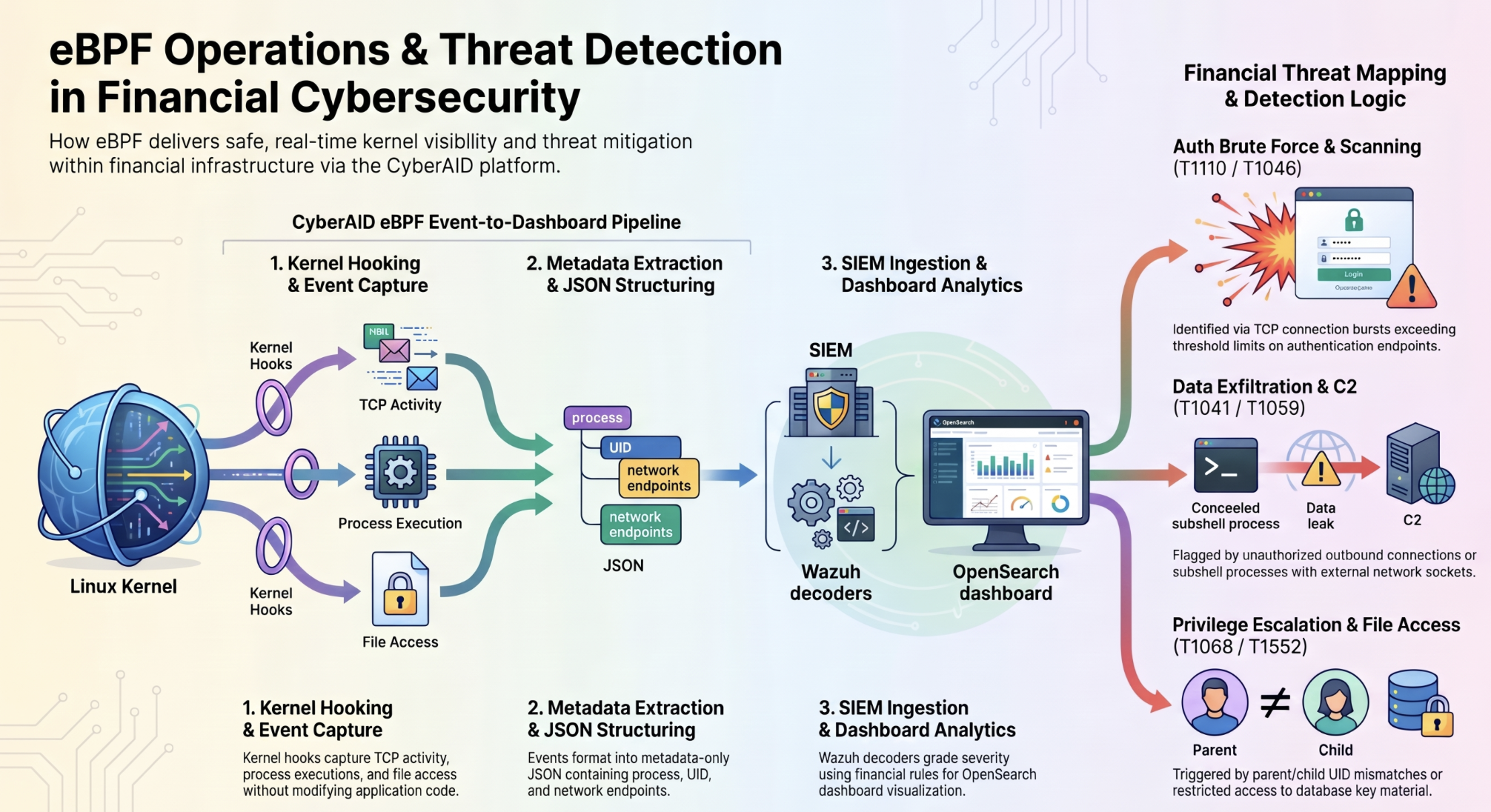
The fifth CyberAId tutorial explores the role of eBPF-enhanced network monitoring in strengthening the cybersecurity and resilience of European financial critical infrastructures. As cyber threats become increasingly sophisticated, eBPF (extended Berkeley Packet Filter) offers advanced capabilities for real-time network visibility, threat detection, security monitoring, and anomaly identification across complex financial IT environments.
The tutorial examines how the CyberAId framework integrates network monitoring capabilities within its AI-driven cybersecurity architecture, which comprises five core architectural groups: presentation interfaces, LLM orchestration, security capability services, integration fabrics, and data layers. It highlights how eBPF-based observability can support the collection and analysis of network and system-level telemetry, enabling more effective threat detection and incident response.
Furthermore, the tutorial discusses how these capabilities can complement Generative AI and Large Language Models (LLMs) to enhance security operations, reduce analyst workloads, and support regulatory compliance. By connecting real-time monitoring with the CyberAId reference architecture and practical pilot scenarios, the tutorial demonstrates how eBPF-enhanced security can contribute to a more proactive, resilient, and secure financial ecosystem.
Discover the The eBPF videos below: